


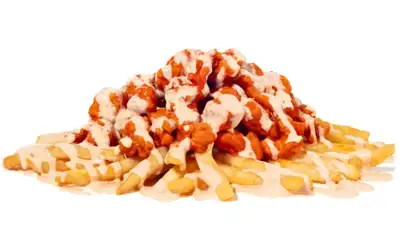
The perfect sauce-to-food ratio is a thin, even coat that clings to every surface without pooling underneath. Too little sauce leaves food dry and one-note. Too much buries the flavor of the chicken, softens the crust, and wears out your palate within a few bites. The most reliable way to hit that balance is to toss hot food in warm sauce right before serving, which is exactly how we sauce every order at The Buffalo Spot.
The best wings hit different, and it isn’t just the sauce. It’s how the sauce clings. Getting that right comes down to a little food science: how sauces flow, how they hold together, and even how their color sets up your expectations before the first bite.
Why Sauce-to-Food Ratio Matters
Sauce is there to amplify the food, not replace it. When a wing is drenched, the sugar, salt, and acid in the sauce crowd out the savory flavor of the chicken. Your taste buds also adapt to strong, repeated signals, so a heavily sauced plate can start to taste flatter as you eat. More sauce doesn’t mean more flavor. It usually means less.
Texture suffers too. Excess sauce adds moisture, and moisture is the enemy of crunch. A precise coat lets you taste the crispy skin, the juicy meat, and the sauce all at once, which is what keeps you reaching for the next one.
The Physics of Coating: Why Viscosity and Emulsions Matter
A great wing sauce has to do two jobs. It needs to spread easily across the wing, and then it needs to stay put. That’s where viscosity comes in.
Many creamy and emulsified sauces are shear-thinning, meaning they get thinner while they’re being stirred or tossed and thicken back up once the motion stops. Food scientists call this pseudoplastic flow, and it’s a hallmark of stable emulsions like mayonnaise, as noted in this study on emulsified sauce rheology. In practice, it means a sauce thins out and spreads evenly while the wings are being tossed, then firms up to hold the coating in place.
Emulsions are mixtures of fat and water that normally don’t want to stay together. Classic Buffalo-style sauces, for example, blend butter with hot sauce. When that emulsion is stable, it coats evenly and tastes consistent from wing to wing. When it breaks, the fat and water separate. Some pieces end up greasy, others get a watery runoff, and the watery part soaks into the crust.
The flavor components of a sauce affect how it behaves, too. Acidity, sweetness, heat, and fat all shape its texture and cling. We dig into those building blocks in our guide to the key flavor components of a great wing sauce. A balanced sauce doesn’t just taste right. It behaves right.
How Sauce Color Shapes Flavor Expectations
You taste with your eyes first. Before a wing reaches your mouth, your brain has already made predictions about how it will taste based on what it sees.
Color is one of the strongest of those cues. Research published in the Journal of Sensory Studies found that red hot sauce generated the strongest expected spiciness of the colors tested, and that more saturated color raised expectations of heat. That’s why a bright red Buffalo sauce reads as bold before you’ve tasted it.
Color can also change how satisfying a sauce feels. In a 2026 study of 100 consumers, researchers served soy sauces with identical salt content in four color intensities. The moderately colored sauce earned the highest liking scores for both color and saltiness, and it was the only sample where what people expected matched what they actually tasted. The lightest sauce scored lowest and was linked to negative reactions like “bored” and “worried.”
- Pale sauces can set up low expectations before the first bite.
- Well-matched color primes you for a flavor that delivers on its promise.
- Mismatched color, like a sauce that looks far bolder than it tastes, can leave you feeling let down.
Ready to put the science to the test? Order online from The Buffalo Spot. Every order is made to order and tossed in your choice of 12 signature sauces.
Saucy, Not Soggy: How We Build Buffalo Fries
Loaded fries are one of the hardest sauced foods to get right. You’re fighting gravity, heat loss, and moisture all at once. Our World Famous Buffalo Fries are built to handle all three.
It starts with fresh fries cooked to order. Next comes chicken that’s hand-cut daily and never frozen, tossed in your choice of sauce. The sauce coats the chicken, not the fries, so the base stays crisp. We finish with a drizzle of our special sauce, ranch, or both. It’s a controlled drizzle, not a flood.
Drown the plate and the structure falls apart. Moisture runs downhill into the fries, and the crunch disappears in minutes. We cover this in more detail in how we keep fries crunchy under sauce.
Practical Tips for Mastering the Sauce-to-Food Ratio at Home
Making wings at home? These habits will get you closer to a restaurant-quality coat:
- Toss, don’t pour: Put wings in a large bowl, add sauce a little at a time, and toss until every piece is evenly coated. Pouring sauce over a plate leaves some pieces bare and others drenched.
- Hot food, warm sauce: Warm sauce spreads more easily and is less likely to break than cold sauce straight from the fridge.
- Drain before you sauce: Let fried food rest on a rack for a moment so surface oil and steam can escape before the sauce goes on.
- Sauce right before serving: The longer sauced food sits, the more the crust softens. Toss at the last minute.
- Keep extra on the side: If you’re a slow eater or serving a crowd, put extra sauce on the side for dipping instead of adding more to the wings.
Planning a group meal? Our guide to ordering for a group without overordering helps you figure out how much food to get, and mixing a few different sauces keeps everyone happy.
Frequently Asked Questions About Sauced Foods
How do you cool down your mouth after eating spicy wings?
Capsaicin, the compound that makes peppers hot, is fat-soluble, so water mostly just spreads it around. Dairy works better because it contains fat and a protein called casein, which helps pull capsaicin away from the receptors on your tongue. If you ordered a little too hot, a shake is a great fix. Here are our favorite milkshake pairings for hot wings and Buffalo Fries.
Why does sauce separate and make food soggy?
Many sauces are emulsions of fat and water. When an emulsion breaks, often because it got too cold, too hot, or sat too long, the fat and water separate. The watery portion soaks into the food and softens the crispy exterior. Keeping sauce warm and tossing right before serving helps prevent it.
How does sauce color affect how it tastes?
Your brain uses color to predict flavor. Red sauces tend to raise expectations of heat, and darker sauces can raise expectations of saltiness. When the color matches the actual flavor, the food tends to feel more satisfying. When it doesn’t, the same flavor can feel disappointing.
How can I keep wings crispy when tossing them in sauce?
Start with wings that are fried until crisp, let them drain briefly, and toss them in warm sauce just before serving. Use enough sauce to coat, not soak, and keep any extra on the side.
Which Buffalo Spot sauce should I try first?
It depends on how much heat you like. Mild and Original BBQ are easy starting points. Lemon Pepper and Garlic Parmesan bring big flavor without the burn. Heat seekers can work up through Original Hot and Very Hot to Atomic Hot. Our heat levels guide breaks down the full lineup.
Visit The Buffalo Spot Today
Great flavor is about balance, not volume. When the ratio is right, you get it all in one bite: crunch, creaminess, heat, and depth, with nothing overwhelming the rest.
Skip the guesswork and let us handle the science. Our chicken is hand-cut daily, never frozen, and tossed to order in your choice of 12 signature sauces. Order online or visit us in Phoenix, Los Angeles, Riverside, Tucson, or at any of our locations across Southern California and Arizona.